
Blackjack basic strategy chart cuts edge from 0.53% to 0.14%
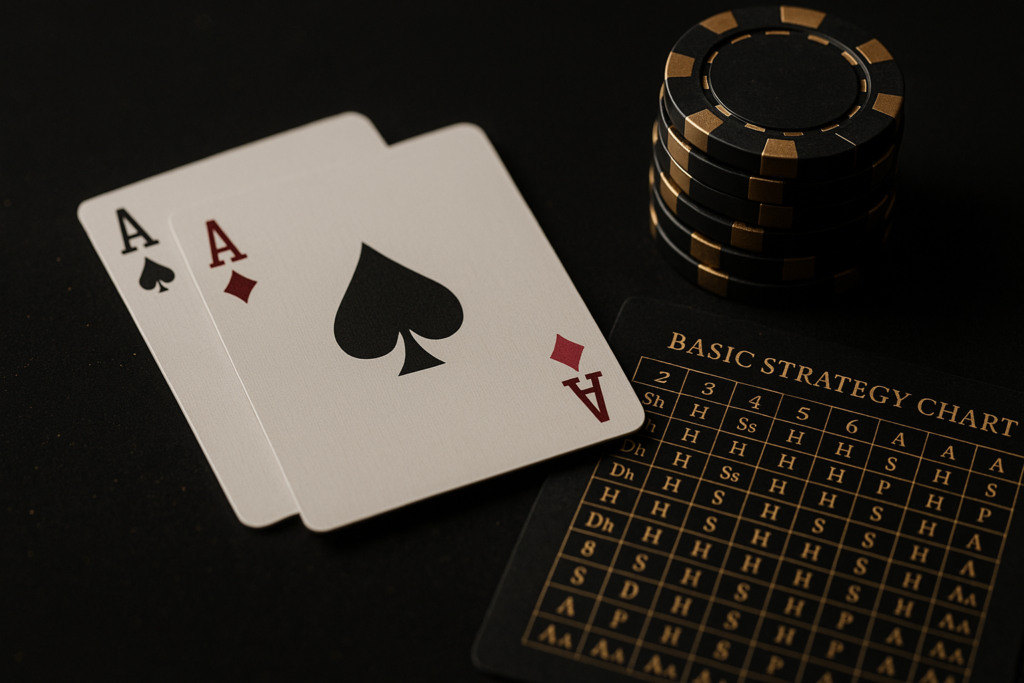
Blackjack Basic Strategy Chart: Match the Chart to Your Table and Cut the House Edge from 0.53% to 0.14% (Hard 16 & Soft 18 Explained) Estimated reading time: 6 minutes Key takeaways Use a rules-matched basic strategy chart for the exact table you’re at—decks, S17/H17, payouts and doubling rules matter. Small rule differences change the house edge by tenths of a percent; matching a chart can reduce expected loss from ~0.53% to ~0.14% under common Strip rules. Generate the exact chart with a strategy tool (for example, the Wizard of Odds generator) and memorize a few high-frequency plays. Why the exact chart matters: decks, S17, payouts and real percentages Basic strategy isn’t a single universal map. It’s a family of maps that shift depending on the table rules. The math isn’t fuzzy—small rule tweaks change the house edge by tenths of a percent. Those fractions matter when you play big or often. For example, the number of decks can swing the edge a lot. One analysis shows the same rule set produced a house edge as low as 0.014% with a single deck and as high as 0.577% with eight decks, holding other conditions constant. That’s not theoretical hair-splitting; that’s why you should care whether you’re at a four-deck shoe or a six-deck tray. Other rule effects are real and measurable too: Late surrender can change the edge by about 0.08%. Allowing doubles on any number of cards moves things roughly 0.23%. Switching from single to double-deck in one comparison was about 0.19%. These figures come from the Wizard of Odds’ analyses and their house-edge calculator, which is where I run numbers before I sit down at a table. When you combine rule differences with a chart that assumes the wrong rules, your “simple” strategy can cost around 0.53%. A rules-matched basic strategy costs closer to 0.14% under liberal Strip-style rules. That’s the heart of why matching matters. How to read a blackjack basic strategy chart Charts look intimidating because they’re dense with letters. But they’re simply a tidy way to pick the move with the best expected return for each player hand vs the dealer upcard. Charts usually split your hands into three groups: Hard hands — no ace counted as 11 (e.g., 10–8 = 18 hard). Soft hands — include an ace counted as 11 (e.g., A‑6 = soft 17). Pairs — two cards of the same rank you might split (e.g., 8‑8). The dealer’s upcard runs across the top, your hands down the side, and each intersecting cell tells you the mathematically best action. Common abbreviations you’ll see: H = Hit S = Stand D = Double if allowed, otherwise hit P = Split Surrender = Surrender if available, otherwise follow the fallback A crucial detail: the chart must state whether the dealer hits or stands on soft 17. That single line changes some decisions and shifts the house edge. If the chart doesn’t state it, don’t trust it for exact play. Generate the exact chart for the table you’re at (step-by-step) Don’t memorize some generic “chart for beginners.” Generate one that matches the table rules. The easiest practical tool I use is the Wizard of Odds strategy calculator—pick your rules, and it spits out the correct chart for that exact rule set. Here’s the checklist to run before you pick or generate a chart: Number of decks Blackjack payout (3:2 vs 6:5) Dealer hits or stands on soft 17 Doubling rules (any two cards or restricted) Doubling after split allowed? Resplitting aces allowed? Late surrender available? Dealer peeks for blackjack? Are blackjacks paid normally after a split? Once you’ve noted those, go to the Wizard of Odds strategy calculator, set the options to match the table, and download or print the chart. It literally builds the exact matrix you need. Two quick tips while you’re at it: If the casino posts the rules on a placard, don’t assume standard—read it. If something’s ambiguous, ask the dealer or floor. Keep the chart as a mental map. You don’t want to be the person consulting a laminated sheet at a crowded table—learn the handful of frequent, marginal decisions and keep the chart for reference. Concrete hands: what a rules-matched chart changes (hard 16 & soft 18) Two hands that regularly cause arguments: hard 16 vs dealer 10, and soft 18 (A‑7) vs dealer 6. They’re good examples because the correct play can flip depending on table rules, and those flips move the expected loss by measurable amounts. Hard 16 vs dealer 10 is the classic “ouch” hand. If late surrender is available, basic strategy commonly recommends surrender for that matchup because the expected loss from continuing is worse than forfeiting half the bet. If surrender isn’t on the menu, the chart gives the fallback—usually hit rather than stand—depending on the rule set in play. The recommendation to surrender against a dealer 10 when allowed is a standard basic-strategy play. Soft 18 sits in the middle: it’s often a stand, but against certain dealer upcards and under some rules it becomes a double or even a hit. Because soft 18 can be played aggressively (double) against a weak dealer upcard, using the wrong chart will push you toward too conservative or too aggressive plays. Those two hands show the point: a few wrong decisions across multiple hands add up. Using a generic/simple chart under Strip-like rules can cost about 0.53%. Matching the chart to the table’s specifics shrinks that extra leak down to roughly 0.14%, per Wizard of Odds’ comparison of simple vs complete strategy under those rules. Which rules change the chart most (short list) If you want to triage what to check first, here are the biggest rule levers that change strategy and edge: Dealer H17 vs S17 — alters soft-hand plays and overall edge; always note it. Number of decks — measurable swing in house advantage between one and eight decks. Late surrender — changes strategy on marginal hard hands like 16 vs 10. Doubling
Win Money Mini Casino Games 96% RTP in 10 Spins

Can You Win Money From Mini Casino Games? What a 96% RTP Really Means for Your Chances Estimated reading time: 4 minutes Key takeaways You can get short-term wins from mini casino games, but a 96% RTP implies a 4% house edge over large samples. Variance drives big short-term swings; RTP is a long-run average, not a session guarantee. Check published RTP, volatility, independent testing and bonus terms before you play. What a 96% RTP means if you want to win money mini casino games RTP stands for return-to-player and it’s the long-run percentage of stakes a game is designed to return. A 96% RTP means the game is set up to give back about £96 for every £100 wagered across a huge sample of plays, which implies a 4% house edge. The key phrase there is “huge sample.” The regulator makes that point. The UK Gambling Commission explains RTP as an aggregate figure, not a guarantee for any one session or player. Expected loss over realistic session lengths (£1-per-spin examples) If you want numbers you can carry to the pub, use a simple £1 stake per spin as our baseline. With a 4% house edge: 10 spins → expected return ≈ £9.60, expected loss ≈ £0.40 100 spins → expected return ≈ £96.00, expected loss ≈ £4.00 1,000 spins → expected return ≈ £960.00, expected loss ≈ £40.00 Those are expectations — averages over many identical sessions. They don’t tell you what will happen in your single 10- or 100-spin run. Short sessions are noisier. Hit a bonus early or land a big multiplier and you could walk away up dozens or hundreds of pounds. That’s why players often report leaving with more than they deposited after a 20-minute run. The technical reason is that outcomes are driven by a random number generator (RNG), so variance can produce big swings on small samples. Why short-term wins don’t make a game profitable Think of the house edge as a slow bleed, not an active hand that takes your money from a single winning session. The 4% edge nudges the long-term average; it doesn’t stop lucky streaks. The regulator’s method for calculating RTP — comparing aggregate winnings against turnover — is precisely about that long-term view. The Gambling Commission’s calculation method shows RTP is meaningful only once you’ve accumulated lots of spins across many players or a long time frame. What variance looks like Mini casino games include everything from tiny slots and scratchcards to roulette-style and crash games. Volatility differs across titles: low-volatility mini-slots may pay often but small, high-volatility crash or multiplier games pay rarely but potentially very large sums. High variance means your 10-spin sample could be wildly different from the 1,000-spin average. That’s not a defect: it’s literally how the game produces big short-term wins. Four checks to do before you try to win money mini casino games Before you play, run these four quick checks. They cut the avoidable risks and make your short-term wins less likely to be nonsense. 1) Published RTP Find the RTP on the game page or provider info. If a title won’t publish an RTP, that’s a red flag. Compare games: a 97% RTP game gives you a 3% house edge instead of 4% — that’s real, small but measurable over hundreds of spins. 2) Volatility Decide whether you want frequent small wins or rare big ones. Volatility doesn’t change the mini casino house edge, but it changes how quickly variance reveals the edge. If you want to preserve bankroll, low-volatility games usually feel calmer. 3) Regulation and independent testing Make sure the operator is licensed and the games are independently tested. Testing labs commonly used in the industry include eCOGRA, iTech Labs, GLI and BMM Testlabs; description of testing practices shows up in trusted reviews like how we review pages. Licensed, tested RNGs mean the claimed RTP and randomness are verifiable. 4) Bonus terms and stake limits If you’re using promotional funds, read the wagering rules. Bonus money can look tempting but often has restrictions and stake caps that wreck your ability to withdraw a short-term win. Also check maximum and minimum stake limits so you don’t accidentally play at a level that ruins your bankroll plan. Concrete scenarios: when a player wins, and when the math wins back Here are three real-ish scenarios that show the push and pull between luck and expectation. Scenario A: Ten £1 spins, hit a £100 multiplier on spin 2 → you can withdraw £100 and leave up £99. Short-term win, pure variance. Scenario B: One hundred £1 spins with a mix of small wins → you finish up £12. That’s a good session, but it’s still well within the variability the 96% RTP allows. Scenario C: One thousand £1 spins → your expected loss is about £40, so if you’ve been playing thousands of rounds you’re much more likely to be down than up in aggregate. The important point: the casino’s advantage becomes tighter as the number of spins grows. That’s why advice like “play a bit and cash out quickly” speaks to variance, not to changing the house edge. How to tilt the odds toward walking away a winner (without illusions) You can’t beat the house edge over the long run, but you can stack the deck in favour of frequent, realistic short-term wins. Prefer higher RTP titles when available: even a 1–2% RTP bump lowers your expected loss per spin. Match volatility to your goal: low volatility for frequent small wins, high volatility only if you’re playing for a rare big score. Set a session length in spins or time. The fewer spins, the more variance can help you. Use fixed stakes. Playing £0.50 one minute and £5 the next magnifies variance without improving expected return. Read bonus T&Cs. If you can’t withdraw a bonus without heavy wagering, the “free” money might cost you. These aren’t tricks to turn a negative expectation into a winning system; they’re ways to make
Replay Poker real money chips bought but no cash out 6467240

Replay Poker real money: You can buy chips — but you can’t cash out Estimated reading time: 4 minutes Key takeaways Replay Poker sells virtual chips that explicitly have no cash value and cannot be redeemed. Buying chips is a purchase of virtual entertainment access — not a deposit into a real-money account. The site operates as a social play-money platform, so there’s no gambling licence or cash withdrawals. Replay Poker real money — the controversy in plain terms People see a “buy chips” button and assume it’s the same as putting money into an online poker account. It looks like a deposit. It feels like gambling. But on Replay Poker the chips are play-money only. The platform’s own help page is blunt: Replay Poker is a play-money poker site and “does not allow gambling for real money or cash winnings.” That’s the centrepiece of the whole discussion and the reason the site isn’t treated like a licensed gambling operator (official help page). What the terms actually say about Replay Poker chips If you want the legalese, the terms spell it out: “Play Money is virtual currency with no real-world value; it cannot be exchanged, transferred or redeemed for money or prizes.” That clause covers both chips you earn at the tables and chips you acquire with your card. The site explicitly allows chips to be purchased with real currency, but also ties up those chips as entirely non-redeemable virtual items (terms and conditions). Why that wording matters Legally and practically, the wording makes Replay Poker a social, play-money service, not a real-money poker room. Chips can be bought, yes — but they’re labelled as having no real-world value. Since they can’t be cashed out, you never receive winnings in cash or prize form. Because of that structure, Replay Poker says it doesn’t provide gambling facilities and it isn’t regulated like a real-money operator (casino.org summary). Replay Poker real money: legal and practical meaning There’s a simple legal domino chain here. If chips have no real value and can’t be cashed out, the activity on the site isn’t “gambling” in the regulatory sense. That’s why Replay Poker operates without a traditional gambling licence and why you won’t see typical real-money metrics like RTP or house edge applied to its tables. Replay Poker is operated by Replay Digital Ltd, a registered company in England and Wales (company number 6467240), which the terms page lists as the operator of the site (company registration details). That’s not the same as being unregulated in a sketchy sense — it’s a different legal category. They’re running a social game platform, not a regulated gambling service. So what’s the practical effect for players? Three things you should expect if you decide to play: You can buy more chips to stay in the action longer, but those chips are just for use on Replay Poker. You can’t convert chips back to money, or transfer them out to another platform or player. Promotions and bonuses are chip-based too, so daily bonuses or tournament tickets don’t pay out in cash either (third-party overview). That last point matters because it changes the incentives. On a real-money site you’re managing bankroll and cash-out timing. Here you’re managing seat selection, practice, and social standing (leaderboards, club play, that sort of thing). How Replay Poker works — games, access and what to expect at the tables The variety is there: Texas Hold’em, Omaha, Omaha Hi/Lo, Royal Poker, Stud and Stud Hi-Lo are all listed as available formats on the platform’s Android page, so you’re not stuck with a single flavour of poker (Android listing). Game types include virtual-chip cash games, sit-and-go tournaments and multi-table tournaments. That mix makes the site useful for learning tournament dynamics as well as cash-game decision-making. Replay Poker is mainly browser-based and mobile-friendly — independent coverage notes there’s no need for a desktop client and that play is accessible in the browser (independent review). What playing there actually feels like It’s social poker. Tables are often filled with casual players trying different things, plus a fair number of regulars who treat chip counts and leaderboard standing seriously. You’ll see loose play, splash pots, and teaching moments — exactly what you’d expect from a play-money ecosystem where the only thing on the line is your virtual stack. How to use Replay Poker for practice and social play (without getting burned) If you’re reading this because you want to improve, or because you want somewhere to hang out and play poker without cash risk, Replay Poker can be handy — as long as you understand the limits. Use it for hand-reading and timing: practice how long you take on tough decisions and how you sequence bets. Try tournament structures: the multi-table events let you practise endgame play and ICM without a bankroll headache. Work on new variants: Omaha and Stud show up on the site, so it’s a low-cost way to learn a new game format. Play for social experience: table talk, etiquette, and dealing with tilt are safer to learn when there’s no cash at stake. Remember: because chips can be bought, you’ll encounter buy-ins that don’t reflect true risk management. Don’t treat loose online play on Replay as identical to a proper cash game where money changes hands. Practical tips Track your hands separately. Treat your Replay sessions like drills — keep a hand history file or notes so you can review actual decisions. Focus on fundamentals: position, pot odds, bet sizing. Those skills transfer directly to real-money games. Use the tournaments to practise bubble play and short-stack strategy — the pressure feels similar even without cash on the line. How to read the “buy chips” button without getting fooled Buying chips feels like depositing. That emotional reaction is natural — but what you’re buying is entertainment and access, not a cash balance you can redeem. Replay’s terms repeat two connected facts: chips may be purchased with real currency, and chips have no cash value. That makes the
Gambling credit score six-year defaults haunt borrowers

Gambling and Your Credit Score: Why Bets Don’t Show on Your Report — But Defaults Can Haunt You for Six Years Estimated reading time: 6 minutes Key takeaways Gambling transactions don’t appear on a UK credit file, but the consequences — missed payments, defaults and high utilisation — do. A default remains on your credit report for six years, so early action (talking to lenders, stopping credit use for gambling) is critical. Lenders also review bank statements and affordability; frequent gambling transfers or overdraft dependence can block major borrowing like mortgages. “Gambling credit score” sounds like it should be a thing, right? It isn’t — at least not directly. As Experian explains, individual betting or gambling transactions aren’t the kind of information that sits on your official credit file. The real danger comes later: missed payments, spiralling balances and defaults — the stuff lenders actually record. A default can stick on a UK credit report for six years, as GamCare states. So does gambling affect credit score — directly or not? Short answer: not directly. Credit reference agencies in the UK track credit accounts and how you repay them, not what you spend your money on day-to-day. Your online casino spins, or a few bets, won’t appear as transactions on your credit file the way a missed loan payment would. That said, the pathway from “I had a bad night” to “my credit score has tanked” is well-trodden. Gambling credit score: the downstream harms that actually hurt your rating Here’s where the story gets grim — and practical. Missed or late payments: If gambling losses mean you miss payments on credit cards, loans or utilities, those late payments are recorded and damage your score. Defaults and collections: Continued non-payment can lead to a default or debt collection. Those actions are logged and have a big impact; remember that a default can remain on a UK credit file for six years. High credit utilisation: Using a large portion of your available credit (maxing out cards or creeping near limits) signals risk to lenders and knocks your score down. Multiple hard searches: Repeated applications for credit to cover losses bring hard credit checks. A cluster of these looks like financial stress to lenders. Using credit to gamble: Borrowing via overdrafts, credit cards or short-term loans to fund gambling doesn’t flag the purpose to the credit agency, but it creates debt that shows on your reports and raises vulnerability. All of the above are documented in consumer guidance and debt-advice sources — they don’t speculate about spending categories. They focus on repayment behaviour and debt levels, because that’s what credit reporting measures. What lenders actually see — and what will trip you up People often equate a credit score with a lender’s decision. They’re linked, but not identical. Lloyds explains that lenders do a broader affordability check when it matters — like for mortgages. That means they can look at bank statements, income, regular outgoings and one-off withdrawals. So even when gambling activity doesn’t show on your credit file, it can still be visible to an underwriter reading your statements. Practical red flags lenders care about Regular transfers or withdrawals to gambling operators on bank statements. Large or increasing overdraft usage and repeated overdraft fees. New, unexplained short-term loans or cash advances from cards. Frequent missed payments, defaults or entries from debt collectors. Clusters of recent credit applications — the “hard-search” effect. Any one of those can be enough to shift a lender from “likely” to “no” — especially on big-ticket borrowing like a mortgage or car finance. Immediate steps to stop gambling from wrecking your credit for years If you’re reading this and realising things are heading that way, don’t panic — act. The sooner you move, the more you limit long-term damage. Quick, lender-facing fixes Stop using credit to gamble. That means no more card cash advances, no fresh overdraft borrowing and no new short-term loans. Contact any lender before a payment is missed. Lenders are more flexible if you talk first and set up a plan. Ask your bank about a gambling-payment block. Banks and building societies are increasingly offering these controls. Prioritise essentials and reported accounts: missed mortgage, rent or council tax payments will hit harder and faster than a single bounced card. If you’re not sure how to start the conversation with a lender, prepare a short, factual explanation of your current income and expenses and propose a realistic repayment plan. Lenders are used to these conversations — they prefer to avoid defaults just as much as you do. Where to get practical help now If debts are building, check guidance at MoneyHelper provides — they cover debt steps and how to approach banks and creditors. If gambling is a problem for you, specialist support and tools are available; GamCare also sets out how gambling can affect finances and credit. For debt-specific solutions and step-by-step options, organisations such as charities and regulated debt-advice bodies outline realistic routes forward. Fixing things if the damage is already done If a default is already on your file — breathe. Six years is a long time, but it doesn’t mean life is over. There are concrete moves you can take to rebuild. Obtain full copies of your credit reports from the main agencies and check line-by-line for inaccurate entries. Set up affordable repayment plans for any outstanding accounts; show positive payment behaviour as soon as possible. Keep credit utilisation low — ideally below 30% of any credit limit — and consider closing unused credit only if it genuinely reduces temptation. Limit new credit applications; too many hard searches in a short time will compound lender concern. If you’re disputing an incorrect default, challenge it through the credit agency with supporting bank statements and correspondence. If the default is correct but you’ve since repaid or arranged a settlement, keep evidence and keep making agreed payments — lenders notice consistent behaviour over time. How risky is using credit to gamble? Very risky. Using
Mines review 2026 – Spribe 97% vs Stake Originals 99%

Mines review 2026 — Spribe 97% vs Stake 99%: which Mines game and settings actually give you the best value? Estimated reading time: 6 minutes Key takeaways Different operator builds of “Mines” change published RTP and multiplier curves, so the same name can mean different real value. A 99% RTP build offers better long-run value than a 97% build, but mine-count choice dominates short-term session variance. Provably fair lets you verify honesty, not profitability — always check the game info for RTP and fairness tools before playing. Introduction — what “Mines” actually is Mines review 2026 starts with one blunt fact: “Mines” isn’t a single game — it’s a 5×5 grid that several developers and operators have built slightly differently, and those choices change your real risk and return. The grid has 25 tiles, you pick how many mines to hide (usually 1–24), and each safe pick grows a multiplier until you cash out or hit a mine. (Source: how Mines works.) Mines review 2026 — RTP showdown: Spribe’s ~97% versus Stake Originals’ ~99% Let’s get the headline numbers out of the way. The Spribe implementation most sites list at about 97% RTP, which is roughly a 3% house edge. That’s been the common public figure for Spribe’s Mines. (Source: Spribe’s 97% RTP.) By contrast, Stake’s in-house take — usually called Stake Originals Mines — is commonly published at 99% RTP, a roughly 1% house edge. That’s the big talking point among players: 99% sounds materially better than 97%. (Source: Stake Originals’ 99% RTP.) Those two numbers matter because, all else equal, a higher RTP reduces the long-run drift against you. But “all else equal” is the catch — Mines implements multipliers and mine-count choices differently across versions, so the practical experience can feel quite different from a raw RTP line. Mines review 2026 — which version I looked at and why version choice matters I compared the common Spribe build that many casinos carry and the Stake Originals variant that a lot of players rave about; both are in public documentation and community discussions. The Spribe build is the one usually pegged to 97% RTP, while Stake Originals’ version is the 99% figure people quote. (Sources: Spribe, Stake Originals.) Why does version choice matter? Two reasons: published RTP and payout mechanics. Some operator-built Mines games advertise a higher top prize or tweak multiplier curves, and that changes how fast the on-screen multiplier climbs when you pick safe tiles. For example, certain in-house versions claim enormous maximum wins — Chips.gg lists a 5,148,297× maximum on its page for a 99% RTP variant — which obviously inflates the headline potential even if the underlying risk is extreme. (Source: Chips.gg maximum win.) How mine-count selection changes your real risk The single most important choice you make in a round is how many mines to place on the 25 tiles. The game’s standard options are 1 through 24 mines, and that decision alone controls the pace and variance. (Source: mine-count selection.) Lower mine counts — slower, steadier, smaller multipliers Choosing fewer mines generally means more surviving picks and smaller step-up multipliers per pick. That’s what makes it attractive to someone who dislikes big swings: you’ll get more chances to cash out small wins rather than bust quickly. Several walkthroughs and reviews point out this exact trade-off. (Source: how mine counts affect payouts.) Higher mine counts — massive potential, brutal variance Crank the mines up and the on-paper multipliers explode, but your chance to survive even a couple of picks collapses. That creates the headline “huge win” moments you see on social feeds, but it’s also where the house edge bites hardest in practice. Review sites repeatedly flag that high advertised multipliers require extremely risky settings. (Source: high mine count volatility.) So does a 99% RTP version actually feel better than a 97% one? Short answer: yes, but with caveats. A 99% RTP reduces long-run expected loss compared with 97%, and that’s meaningful if you play many rounds. The difference between 1% and 3% house edge is the difference between losing £1 for every £100 wagered versus about £3 over the long run — the math behind those percentages is cited in public summaries of each version. (Sources: Spribe RTP, Stake Originals RTP.) But in real sessions the multiplier curve and mine-count choice dominate short-term variance. If you play 20 rounds a night using 1–2 mines, the 99% edge will show up slowly. If you’re blasting high-mine rounds chasing a 10,000× pop, variance will swamp that 2% RTP gap in the short term. Provably fair: transparency you can check, but not a free lunch Several Mines implementations let you verify results with a provably fair system (server seed, client seed, nonce). That’s hugely useful if you want to confirm the game outcome wasn’t tampered with. Spribe and a number of operator-built games offer this verification, and the mechanics are documented in platform pages. (Source: provably fair verification.) What provably fair does not do is erase the house edge. Multiple reviews note that provably fair proves fairness of result generation only; it doesn’t change published RTP or multiplier curves. In short: provably fair verifies honesty, not profitability. (Source: provably fair explanation.) Practical Mines game strategy for 2026 — risk-averse vs high-risk players No pick pattern or cash-out ritual defeats the house edge. That’s been a consistent conclusion across reviews and explainers. Changing mines and cashing out manage volatility, not expected return. (Source: no guaranteed winning strategy.) Still, you can manage how the money feels in your hands. Below are pragmatic approaches tuned to player type. Risk-averse players — play the 97% or 99% versions with low mine counts and small stakes: Use 1–3 mines on the 25-tile grid and cash out after one or two safe picks to lock in frequent, modest wins. The Spribe version at 97% is fine here, but if you have access to a 99% operator build, it gives slightly better long-run value. (Sources: Spribe 97%, Stake Originals 99%.) Balanced
Slots Temple review 2026 UKGC license 58086, 1,000+ slots
Slots Temple review 2026 — UKGC-licensed, tournament-first casino with 1,000+ slots, £10 deposits and a £2 dormancy fee you must know about Estimated reading time: 6 minutes Key takeaways UKGC-licensed, tournament-first casino with a library of 1,000+ slots and recognised providers. £10 minimum for deposits and withdrawals, limited payment options (cards and bank transfer), and a £2 monthly dormancy fee. Frequent tournaments — some advertised as no-deposit — aimed at competitive slot players and leaderboard hunters. Short version Short version up front: this is the site for people who want to play slots and treat tournaments like a sport — lots of machines, frequent competitive events (some with no-deposit entry), and a proper UK regulator on the door. That said, limited payment options, a £10 minimum for deposits and withdrawals, and a £2 monthly dormancy fee mean it’s not the simplest option if you want fast, flexible cash movement. This is my Slots Temple review 2026, focused on whether UK players should care. Who runs Slots Temple and does it have a UKGC licence? Slots Temple is operated by Digital Division Ltd, a UK-registered company (company number 09574591), which is worth checking if you like that sort of thing — it’s all in the operator’s legal notes. The operator states it’s regulated by the UK Gambling Commission, and independent coverage matches that up, listing the UKGC licence number 58086 and the remote licence reference 058086-R-334182-001. I still recommend confirming the licence entry yourself on the regulator’s public register if you’re about to move money across. Those facts line up in the site’s own terms and in independent reviews, so this isn’t some fly-by-night operation — it’s a UK-facing, UK-licensed brand that’s been building a slots-first identity. Slots Temple review 2026 — the games: 1,000+ slots and recognised providers If you’re the sort of player who judges a site by how many reels it has, Slots Temple will mostly pass the sniff test. Reviews in 2026 describe a catalogue of more than 1,000 slots, and the platform leans heavily into free-play and tournament-style slot action. That library isn’t a mash of no-name titles. You’ll find games from established studios like NetEnt, Play’n GO, Quickspin and Pragmatic Play, among others. Those providers show up consistently in independent write-ups, so you’re not stuck with a tiny or sketchy supplier mix. Expect the usual variety: classic 3-reel retro themes, high-volatility modern video slots, and titles built for leaderboards and tournaments. If you like hunting for content updates, the site adds and rotates games often, so the “1,000+” number is a moving target. Why the tournaments matter — and what the Slots Temple tournaments actually are Tournaments are the core selling point. Slots Temple has pushed a “tournament-first” feel: regular competitions, leaderboard prizes and, notably, promotional events that can be entered without a deposit. These tournaments range from short sprints (play this title for an hour and top the leaderboard) to longer events where cumulative points matter. Prizes are cash or other rewards, but the exact value and eligibility change by promotion — always read the rules for each event. The tournament angle does two things: it gives casual spins some extra purpose, and it turns low-stakes play into something competitive. For people who like leaderboards and cheeky prize-pool chases, that’s the draw. No-deposit competitions — really? Yes — at least some of the promotional tournaments have been advertised as no-deposit-style events. That’s possibly the biggest differentiator for players who want a low-commitment way to compete for real prizes. But don’t assume every tournament is deposit-free; the terms change and the promotions page is where the fine print lives. Slots Temple review 2026 — payments, withdrawals and the £2 dormancy fee Here’s where the practicalities bite. Slots Temple keeps payment options deliberately simple: the common methods reported are Visa and Mastercard debit cards and bank transfer. No wide e-wallet roster, no crypto bells and whistles in the main coverage I’ve seen. There’s a stated £10 minimum for deposits and withdrawals. That’s relevant if you like to move small amounts around or test a site with a fiver — you can’t here. The site’s terms and independent reviews also spell out some UK rules: UK customers can’t deposit by credit card, and payments must come from an account in the player’s own name. That’s standard UK compliance, but worth flagging if you normally use third-party payment paths. On top of that, an £2 monthly dormancy fee may be deducted from inactive accounts. It’s in the site’s terms: if you let the account sit long enough, the wallet can shrink month to month. Slots Temple withdrawals — what to expect in real time Processing times vary depending on the method and any verification checks. Some reviews put card withdrawals at up to several business days, with bank transfers potentially longer. Other sources give ranges from 0–48 hours to 0–3 business days, which suggests that if your account is fully verified, you can sometimes get money out quickly. So: it’s not a lightning-fast payout promise like some modern apps, but it’s also not in the “weeks” category. The variance comes down to verification and the chosen payment route, according to independent coverage. If you’re planning to play tournaments with small payouts, that £10 withdrawal floor matters. Hitting a £5 leaderboard win won’t clear the cash out for you. Mobile, reputation and what other reviewers are saying User feedback is broadly positive but mixed in specifics. Trustpilot shows a substantial number of customer reviews for the brand, and the UK App Store listing reports a 4.6/5 rating from 322 ratings — those are real people giving impression-level signals rather than a guarantee of anything. Independent review outlets have given decent scores: WagerPals rated the site 4.0/5 in a July 2026 review, and Bonus Kings put it at 7.2/10. Those sites call out the tournament focus, the game library and the UKGC status as wins, and the payment limitations and requirement to check promotion-specific terms as the main downsides.
Germany vs Greece prediction 2-1 win Augsburg Sept 27 2026

Germany vs Greece prediction: Why Germany should edge Greece 2–1 in Augsburg (Sept 27, 2026) Estimated reading time: 5 minutes Key takeaways Germany enter as clear favourites at the WWK Arena, backed by rankings and model probabilities. Greece’s compact, counter-heavy approach makes a Greek goal likely — expect both teams to score. Projected XIs highlight Germany’s attacking firepower (Wirtz, Adeyemi, Kimmich) versus Greece’s direct forwards (Pavlidis, Douvikas). Germany vs Greece prediction: why home turf and firepower nudges Germany ahead September 27 in Augsburg is more than another Nations League date — it’s Germany’s first home fixture after the 2026 World Cup, and that alone makes this Germany vs Greece prediction worth circling. There’s a simple, honest starting point: Germany are stronger on paper and playing at the WWK Arena. The German FA itself listed this as one of the home games in Augsburg, and home advantage after a World Cup carries weight — fresh crowd, familiar routines, fewer travel wrinkles. International rankings back that up. The available match listing shows Germany 12th and Greece 46th in the FIFA rankings, which isn’t decisive on its own but frames expectations. Stat models also favour the hosts: one model gives Germany roughly a 61% win probability. That aligns with the general consensus among previews — most have Germany winning, and a fair few land on 2–1 as the likeliest scoreline. Why not a rout? Because the case for Germany isn’t purely defensive discipline; it’s largely attacking promise. Names like Florian Wirtz and Karim Adeyemi give Germany a genuine chance to break any Greek low block, especially when Kimmich drops in to orchestrate. Why Greece will still find the net (and make this close) Greece aren’t here to make up the numbers. Their projected forward pairing, Vangelis Pavlidis and Anastasios Douvikas, can punish spaces — especially from transitions or set plays where Germany have looked shaky in recent friendlies and qualifiers. The expected Greek XI is compact and pragmatic, a XI that invites pressure and looks to hit on the counter. Those projected names come from the same previews that gave us the German lineups, so they aren’t fantasy picks — they’re the players the staff are actually considering. Put bluntly: Germany’s defence has been a talking point for weeks. If you expect a clean sheet, be ready to be disappointed — several outlets explicitly list “both teams to score” as a reasonable outcome for this fixture. Projected lineups and how they match up Germany (projected) Projected names include Marc-André ter Stegen in goal, a back four with Jonathan Tah and Nico Schlotterbeck at centre-back, and Nathaniel Brown at left-back, with Kiliann Sildillia or Treu at right-back. Midfield looks likely to be Joshua Kimmich morphing into the metronome, with Felix Nmecha alongside him. The attack’s the headline: Karim Adeyemi on the shoulder runs, Florian Wirtz pulling strings, and Marvin Burkardt or Chris Führich filling in wide depending on form. These are projected lineups, not final sheets — but they give a clear sense of how Germany will try to control the match. Greece (projected) Greece’s likely XI starts with Konstantinos Tzolakis in goal and pieces together a defence featuring Konstantinos Mavropanos and Panagiotis Retsos at centre-back, with Kostas Tsimikas out wide. Midfield is a mix of grit and creativity with Petros Kourbelis and Christos Zafeiris, while Christos Tzolis and Konstantinos Karetsas provide the forwards with service. Up front it’s Douvikas and Pavlidis — physical, direct, and dangerous on counters. The Greek blueprint is obvious: sit compact, frustrate, and then move quick when space opens. Against a Germany team still testing defensive partnerships, that’s a viable game plan. What the wider previews and numbers actually say Most mainstream previews land on a narrow German victory; Sports Illustrated, SportsMole, and other outlets are grouped around 2–1 as a recurring scoreline. One statistical model I mentioned earlier gives Germany 61% to win, with draws and Greek wins much less likely. Market pricing also reflects a clear favourite — the moneyline market displayed for the fixture makes Germany the expected winner by a comfortable margin, while the draw and Greece are longer shots. Not every outlet is identical. A few previews push a 3–1 result for Germany, suggesting a slightly messier defence but more clinical finishing. The sensible middle ground is a Germany win where Greece get at least one goal — hence a 2–1 call. How the match will probably play out (minute-by-minute feel) First 15 minutes: Germany presses, Wirtz drops deep to link play, Kimmich picks pockets in the half-spaces. Greece sit in a low block and try to disrupt rhythm. 20–35 minutes: A breakthrough feels likely here. Either Adeyemi sneaks in behind for a one-on-one, or a set piece from Kimmich/Nmecha produces a tap-in. If Greece concede early they’ll open up and look for counters. Half-time scoreline: 1–0 Germany — plausible and the sort of slender lead Germany often carry into the break in transitional phases. 50–70 minutes: Greece’s plan to stay compact pays off. A cleared corner or a quick counter finds Pavlidis, who nods in the equaliser. Germany have created chances but struggled to shut down quick transitions. 75–90+ minutes: Germany turn down the tempo, patient build-up reshapes the game. A late winner arrives — a Wirtz curling effort, an Adeyemi flash-run and finish, or a Burkardt nibble from a chaotic box scramble. Final score: Germany 2–1 Greece. Both teams have scored. Germany win but not by a comfortable margin. Germany vs Greece preview: players to watch Florian Wirtz — the playmaker who can unlock Greece’s compact lines with a single pass or a late run into the box. Karim Adeyemi — pace, timing, and a knack for getting behind defences; Greece’s high defensive line could be punished. Joshua Kimmich — not a flashy shout, but his control of space and set-piece quality will define Germany’s tempo. Vangelis Pavlidis — Greece’s best aerial outlet and a realistic threat on counters and corners. Anastasios Douvikas — intelligent movement and link play, makes Greece
Armenia 2–0 Latvia in Yerevan on Sept 25 Nations League

Armenia vs Latvia prediction: Why Armenia should win 2–0 in Yerevan (Nations League, Sept 25) Estimated reading time: 3 minutes Key takeaways Market and venue signal a modest Armenia edge — opening line around Armenia -120 with a 2.5-goal total. Home advantage in Yerevan plus squad depth and game management point to a tidy 2–0 win for Armenia. This projection is data-backed but cautious: no confirmed line-ups or live injury updates were available. Short version I’m leaning Armenia 2–0. The match on September 25, 2026 at the Vazgen Sargsyan Republican Stadium in Yerevan lines up as a narrow-to-moderate Armenia edge — home pitch, clearer squad depth on paper, and an early market tilt (opening line ~Armenia -120) all point that way. This is an analytical projection, not an insider report — confirmed line-ups and injury news weren’t in the data I pulled. Armenia vs Latvia prediction — the headline case for 2–0 Why 2–0 specifically and not 1–0 or 3–1? Think of it as a controlled home win: Armenia favoured, but not a runaway. The early market shows a modest favourite and a 2.5-goal total, which implies a one- or two-goal margin typical of a tight home victory.ESPN schedule That’s the quantitative backbone. The qualitative side is simple: Yerevan is a place where Armenia typically presses and asks visiting teams to do a lot of work, and Latvia are a solid outfit but not one you’d label elite in Europe right now. Put those together and a 2–0 scoreline — one early goal, another to seal it later — is a comfortable middle ground. Armenia vs Latvia prediction — market signals you should know The opening line landed at about Armenia -120, with a 2.5-goal total listed in the market information I pulled from ESPN. That line isn’t a shout-it-from-the-rooftops favourite; it’s a market leaning that says Armenia is expected to win but the game is competitive. When a home team opens around -120, you usually expect a single-goal margin or a 2–0 as a plausible end-state rather than something one-sided. If you want the fixture confirmation, UEFA’s team-by-team fixture listing has Armenia vs Latvia scheduled on September 25 as part of the league phase. UEFA fixture listing Home advantage: the Yerevan factor Never underestimate the stadium and travel routine in this setup. The game is at the Vazgen Sargsyan Republican Stadium in Yerevan, which gives Armenia the obvious comforts: familiar surface, home crowd, same pre-match routines and no long haul for players. Those things matter in Nations League fixtures, especially for teams outside the traditional top tier of Europe where marginal advantages swing results more often. Squad depth and match management — why Armenia should be able to see the game out I’m calling squad depth a factor because in a cluster of fixtures like this — mid-September, early in the campaign — the ability to replace tired legs and shift tactics matters. We don’t have confirmed line-ups in the data I used, so this is a pragmatic point: if Armenia can rotate and still keep shape, they’re the kind of side that can score, then manage the game to a clean sheet. Latvia have quality, but the combination of an attacking home setup and sensible game management usually favours the hosts here. Where this projection is cautious — what could upset the 2–0 call Be blunt: the model’s only as good as the inputs. The data I have does not include confirmed starting XIs, up-to-the-minute injury lists, or a granular recent-form breakdown for each team. That matters because a surprise absence or a fresh tactical idea from Latvia could flip the script. If Armenia are missing a key creative player or Latvia bring in an in-form forward, the expected margin narrows quickly. So this is an analytical projection that blends early-market signals, venue and a general squad-depth read — not a guaranteed result. Why this is the best next-day Nations League pick On September 25–26 the schedule is stacked: Italy vs Belgium, Türkiye vs France, Georgia vs Northern Ireland and others headline the weekend. But those big fixtures come with layers of uncertainty — rotation, tactical chess, and managers protecting players for leagues. Against that backdrop, Armenia vs Latvia looks like the pick with the cleanest baseline signal: a clear home advantage, an early market lean, and fewer wildcards than the heavyweight matches. You can see the wider slate listed in the general fixtures coverage. Sporting News schedule Match timing context The game is scheduled for a midday kick in ESPN’s listing — 12:00 p.m. — which often means both managers opt for a proper starting XI rather than extreme rotation. ESPN schedule How to read the 2–0 line in matchplay terms Picture the game unfolding like this: Armenia takes the initiative in the first 25–30 minutes, finds a goal from structured possession or a set-piece, then Latvia push for an equaliser and leave space. Armenia gets a second from a break or a well-executed phase, and then the hosts shift to control modes — tighter defensive lines, a substitute to run down the clock, simple but effective possession football. That sequence matches a 2–0 final score and tracks with markets that expect a competitive but decisive home outcome. Small tactical notes fans might care about Set-piece importance: in tight matches between closely matched nations, dead-ball situations often decide games. Game management: a one-goal lead in the second half typically invites tactical conservatism from the home side. Travel and atmosphere: Latvia’s travel and the Yerevan crowd are practical edges for Armenia in a compact Nations League window. Quick timeline — why now matters The Nations League league phase started on September 24, with Matchday 1 running through September 24–26 and Matchday 2 scheduled shortly after. UEFA league phase info Early fixtures in a new international window often produce conservative gameplans. That environment suits a 2–0 projection: marginal superiority converted into a tidy two-goal margin rather than a shooting gallery. If you’re following markets, keep stakes sensible —
Bwin sportsbook review shows 30,000 markets a day, but country limits apply

Bwin sportsbook review — 30,000 markets a day, Bet Builder, 2UP and what’s actually available by country Estimated reading time: 6 minutes Key takeaways bwin legitimately advertises “more than 30,000 markets a day”, reflecting breadth across many sports and niche lines. Core tools include Bet Builder, Edit Bet, cash-out, accumulator boosts and in-play markets, but responsiveness and granularity vary by app and event. Feature and promotion availability is jurisdiction-dependent; local licences and domains control what you actually see. Verify important features (2UP, boosts, cash-out speed) in your country and test with low stakes first. bwin sportsbook review — what “30,000 markets” actually looks like The “30,000” figure comes from bwin’s app listing, which promises more than 30,000 markets a day. That’s not a marketing flourish so much as a description of scale: thousands of football lines, hundreds of tennis markets, plus niche events in horse and greyhound racing and other sports. When you see a number that big, it’s made up of lots of small markets — player props, alternative totals, same-game multi permutations, and markets on lower-tier leagues. The app explicitly covers major competitions, like the Premier League, Bundesliga, La Liga, Serie A and the Champions League for football, and the Grand Slams plus ATP/WTA events for tennis, so the headline isn’t empty. That breadth is useful if you like tinkering with accumulators or hunting down obscure player props. But it also means the interface and filters matter a lot — having 30,000 options is great until you spend ten minutes trying to find the one statistic you want. Core tools: Bet Builder, Edit Bet, cash-out and accumulator boosts bwin packs the usual toolkit you’d expect from a full-service operator: Bet Builder and Edit Bet, cash-out, accumulator boosts and in-play markets across hundreds of events, according to the app descriptions. Each tool has a straightforward job: Bet Builder — combine selections from the same match into a single market (same-game multis). Edit Bet — change a stake or selection post-purchase under certain conditions. Cash-out — settle a bet early for a guaranteed return before the final result. Accumulator boosts — enhanced returns on multi-leg bets when the boost is active. Those features are listed on bwin’s app pages and are core to the product’s positioning: wide markets plus flexible tools for shaping a bet. I’ve used similar toolsets across other apps — the difference often boils down to how quickly the app applies an edit or cash-out during live action, and whether the Bet Builder supports the granular markets you actually want. The bwin 2UP feature — handy, but not universal bwin promotes a football-oriented early-win mechanic called the 2UP feature, which settles a qualifying selection as a winner if the chosen team takes a two-goal lead, even if they don’t hold on to win. Important caveat: availability is market-dependent. The app notes that 2UP applies only in some jurisdictions — it’s not a universal promise you can use everywhere. bwin sportsbook review: country-by-country reality (UK, DE, IT, ES, ON) This is where a lot of people expect one product and find five slightly different ones. bwin’s international footprint is split across licensed operators and market rules, so what’s on offer in one country can differ in another. At a high level, bwin’s international operation is tied to ElectraWorks Europe Limited and carries a Malta licence (MGA/CRP/688/2019) for some domains and markets, but local licensing matters too. Independent trackers show bwin-branded operations are licensed or authorised in multiple markets — including Great Britain, Spain, Italy, Germany and Ontario — but the list isn’t identical everywhere and it’s updated over time. That’s documented in market reports for the brand’s licence status. What that means for the five big markets people ask about: United Kingdom: bwin has local authorization in GB, which implies product localisations, market-specific promotions and UK-regulated responsible gambling rules. Expect Bet Builder, in-play and cash-out where the licence permits. Germany: Germany is on the list of authorised markets. bwin operates a German site and local pages that reflect the product available under German rules. Italy and Spain: Both countries appear in the licence/authorisation listings, and their regulatory regimes typically mean market-specific offers and limits on promotion mechanics. Ontario (Canada): bwin-branded services appear in Ontario under the relevant local authorisations, which again can change which features and promos are available. Short version: if you live in one of those countries, you’ll generally have access to a full feature set, but the exact promotions, payment methods and even which in-play markets are offered will be controlled by the local licence holder. Don’t assume a bonus or a feature listed on one bwin domain is available on another. Using the bwin sports app — how it feels in real life The app listings (Android and iOS) make the product positioning clear: pre-match and in-play markets, live betting, Bet Builder, cash-out and more. The Android store highlights the daily market count and live coverage; the iOS pages mirror the feature list. Practically, that translates into a familiar experience: a main navigation for sports, a live hub for on-going events, and a match page where the Bet Builder and props live. I’ll be frank — once you’ve used big sportsbooks a few times, the differences are in responsiveness and polish rather than raw features. Two real, practical checks I’d run before committing time or money: Confirm the specific features available in your country and whether 2UP or accumulator boosts are offered there. Try the cash-out during a live event to see how fast the app refreshes offers; slow refresh rates during a key stoppage are the single most annoying thing in live markets. The app pages say live betting is supported across hundreds of events; that’s good, but “hundreds” can mean everything from top-tier football to late-night tennis matches on smaller tours. If you need a particular niche market, search before you commit. Where the 30,000 claim runs into real limits Here’s the fine print people miss: scale ≠ uniformity. The 30,000
England vs Spain prediction 1-1 in Nations League opener

England vs Spain prediction: Nations League opener likely to finish 1-1 as both sides test post-World-Cup lineups Estimated reading time: 4 minutes Key takeaways This Nations League opener is the first competitive reset after the World Cup and teams will prioritise measured changes. The opening 30 minutes will probably decide tempo and whether the match stays cautious or opens up. Prediction: a tidy, low-scoring draw — likely 1-1 — unless one side forces the issue early. England vs Spain prediction: I’m going to be blunt — this one looks like a careful, low-scoring chess match rather than a fireworks show. The Nations League opener on 26 September 2026 is the first real competitive snapshot after the World Cup, and both managers are likely to bring fresh faces and tweaked tactics rather than full‑throttle attacking gambits. Why this matters now: the first post‑World‑Cup test Matchday 1 is scheduled for 24–26 September, and England vs Spain sits squarely on the Saturday slate on 26 September 2026, so this isn’t a throwaway friendly — it’s competitive, and it counts in League A (Matchday calendar from UEFA). That calendar matters because, as a round‑one preview put it, this Nations League cycle is really “the first competitive reset after a World Cup” — a moment when retirements, new talents and tactical overhauls begin to show up on a proper scoreboard rather than in training snippets (analysis from a Round 1 preview). In plain language: both nations will want results, but they’ll also want to see how their post‑World‑Cup experiments survive the heat of a real game. That usually produces conservative starts, and that’s a big reason why a 1-1 feels plausible. England vs Spain prediction — decisive opening 30 minutes The one thing I’ll say with confidence: the match will be decided most by how either side adapts in the opening half hour. Why 30 minutes? Because that’s when managers get the first real read on the new players and the tactical tweaks they’ve been working on. If England or Spain get the early rhythm in attack, they can press the honeymoon period and force changes. If not, both are likely to pull back and try to grind out a result. How managers usually react early From what we’ve seen in recent international windows, coaches tend to start cautiously when they’ve integrated new names — they don’t want to blow the formation or get punished on a counter. The opening 30 is the time to test pressing triggers, passing lanes and how new midfield partnerships hold up under pressure. So the prediction isn’t just a score guess. It’s a view on tempo. If England show their usual early intensity and find a forward rhythm, Spain’s possession game could look a little blunt. The reverse is true if Spain control the ball early and force England to chase. Either way, the first half-hour sets the tone for a low‑scoring finish. An honest England vs Spain preview: structure, schedules and context This fixture is one of several heavyweight matches on Matchday 1 — Italy vs Belgium, Turkey vs France and the Netherlands vs Germany also headline the opening window. The schedule puts a lot of top teams into competitive action right away (UEFA’s league‑phase fixture list), which pushes managers into serious selection choices rather than easy rotation. That context matters because teams coming off deep World Cup runs have differing motivations. Some want to consolidate a core, others want to accelerate a generational shift. England and Spain both fall into the latter group: tweaks rather than wholesale rebuilds, but definite evolution. Dates and the importance of a competitive reset To be specific: Matchday 1 runs 24–26 September, Matchday 2 27–29 September and Matchday 3 is planned for 30 September–3 October, so this opening fixture kicks off a condensed period where early points and momentum matter a lot (UEFA matchday schedule). The short window magnifies the risk of rushing in inexperienced options, so expect both managers to strike a balance — pick plausible starting XIs while keeping tactical safety nets in place. How both sides will rotate: cautious integration of new talent Neither country is likely to rip the plaster off and go all‑out attacking with untested units. Instead, managers will phase in promising players — minutes in, not full responsibility day one. That’s the predictable, sensible approach after a World Cup where squad cohesion and match fitness were at a premium (round‑one preview notes this trend). A practical consequence: starting lineups will include a mix of established internationals and a couple of trialists. That kind of hybrid XI often produces strong organization but not always fluid attacking transitions, which again points toward a tightly contested scoreline. What to expect from the England Spain lineups Conservative defensive shape early, to protect new midfield links. Gradual substitution pattern: attacking changes in the second half if the game is tied. Managers testing pressing triggers and fallback structures rather than wholesale tactical risk. We don’t have official squads published in the research summary, but the pattern is clear: caution with minutes and intentional substitutions rather than being brave in the starting XI. That’s the safe call for both camps on 26 September. Tactical picture: what each side will try and where the game will open up Both teams love control — Spain through possession, England via structured transition — but the post‑World‑Cup iterations are experimenting with subtle changes. Expect Spain to aim for longer spells of possession with a sharper edge from newly integrated forwards. Expect England to test verticality and quick switches from midfield. Crucially, the match will open up if one side wins individual battles in the first 30: midfield duels, second‑ball wins, or successful diagonal passes behind the full‑backs. Those are the moments that create half‑chances and make a conservative game tilt toward more goals. Likely game flow First 30 minutes: probing, cautious, few clear-cut chances. Second half: tactical tweaks and substitutions aim to create openings. Late stages: one team will press for the win, the other